Enterprise AI Voice Infrastructure
Build Human-Like Conversational AI with Enterprise AI Voice Infrastructure
High-quality multilingual conversational datasets and emotionally expressive speech recordings for next generation voice AI
Voice is becoming the primary interface between people and AI, driving demand for more natural, human-like interactions. Building these systems takes more than traditional speech recognition data. It requires diverse, multilingual datasets with authentic conversations, emotional expression, regional accents, natural speech patterns, overlapping speakers, and cultural context.
DataForce delivers end-to-end voice AI data services, combining global participant sourcing, professional-grade recording, annotation, validation, and quality assurance to produce production-ready datasets for conversational AI, voice agents, robotics, automotive, healthcare, and multimodal AI. Backed by decades of multilingual data expertise and TransPerfect Media’s recording infrastructure, organizations can rely on a single partner to support the entire voice AI data lifecycle.
Why Voice AI?
Voice is quickly becoming the preferred way people interact with AI. Advances in large language models, natural speech synthesis, and multimodal AI are enabling faster, more natural conversations across everyday products and enterprise applications.
Where AI is being used
| 🤖 AI Assistants | 🎧 Customer Service |
| 🏥 Healthcare | 🚗 Automotive |
| 🤖 Robotics | 🎓 Education |
| ♿ Accessibility | 💼 Enterprise Copilots |
Why Next-Generation Voice AI Requires Different Data
Traditional speech datasets were built for automatic speech recognition (ASR) and text-to-speech (TTS). Today’s voice AI models must understand and generate natural conversations, requiring richer, more representative training data.
| Traditional Speech Data | Next-Generation Voice AI Data |
| Isolated words and sentences | Natural, multi-speaker conversations |
| Scripted prompts | Authentic dialogue and turn-taking |
| Neutral speech | Emotional expression and speaking styles |
| Limited accents | Regional accents and dialects |
| Single language | Multilingual speech and code-switching |
| Controlled recordings | Real-world acoustic environments |
| Basic transcripts | Rich metadata for training and evaluation |
What Is AI Voice Infrastructure?
AI voice infrastructure is the end-to-end ecosystem for creating production-ready voice datasets for modern AI. It brings participant recruitment, recording, transcription, annotation, quality assurance, metadata engineering, and secure delivery into one managed workflow.

Global participant recruitment
Native speakers, target demographics, regional accents, dialects, and domain-specific profiles

Professional recording
Certified studios, professional home studios and managed remote recording workflows

Voice direction
Emotional tone, speaking style, pacing, and conversational authenticity

Transcription and annotation
Transcripts, diarization, timestamps, emotion labels, acoustic events, intent classifications, and custom metadata

Quality assurance
Audio review, metadata checks, annotation validation, and delivery acceptance

Dataset engineering
AI-ready packaging of recordings, transcripts, annotations, metadata, manifests, and documentation
The End-to-End AI Voice Lifecycle

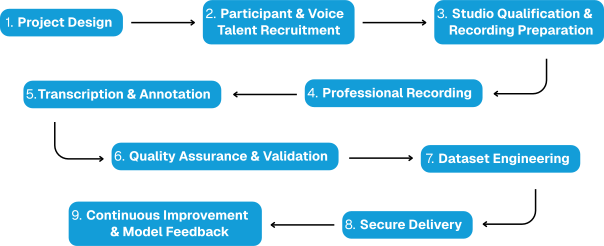
DataForce manages this lifecycle through a single integrated program, reducing handoff risks and helping enterprise teams scale multilingual voice AI initiatives with confidence.
Why DataForce
Enterprise AI Voice Infrastructure Built for the Next Generation of Conversational AI
Building world-class voice AI requires more than collecting audio. It demands coordinated recruitment, studio operations, voice direction, transcription, annotation, metadata engineering, quality control, and governance across language and markets.
DataForce combines global AI data operations with TransPerfect Media production capabilities to design, manage, and deliver production-ready voice datasets from planning through final delivery.
| Pillar | Capabilities |
| Data sourcing | Global participant recruitment; native-speaker validation; demographic targeting; under-resourced language coverage. |
| Production | Professional studios; certified home studios; managed remote recording; voice talent; performance direction. |
| Data operations | Transcription; annotation; metadata enrichment; QA; dataset engineering; secure delivery. |
| Governance | Enterprise project management; workflow oversight; quality gates; security controls; delivery documentation. |
Global Voice Data at Scale
Modern voice AI must understand how people communicate across languages, accents, regions, cultures, demographics, and real-world contexts. Building these systems goes beyond translated prompts, relying on voice datasets that reflect the markets where AI will be used.
| Dataset Dimension | Examples |
| Language and region | Native speakers, dialects, regional accents, code-switching, and local expressions. |
| Speaker diversity | Age groups, gender balance, socio-economic backgrounds, professions, and speaking patterns. |
| Conversation style | Natural pacing, interruptions, hesitations, emotional expression, and authentic dialogue. |
| Cultural context | Local references, communication norms, and market-specific language use.Local references, communication norms, and market-specific language use. |
Under-Resourced Languages
Many of the fastest-growing digital economies remain significantly underrepresented in existing voice datasets. DataForce supports organizations expanding voice AI beyond high-resource languages by combining localized recruitment, native-speaking reviewers, culturally informed project management, and flexible production workflows.
Priority regions may include Central Asia, Southeast Asia, Africa, Eastern Europe, Latin America, and the Middle East.
Beyond Language: Capturing Human Diversity
Communication is shaped by age, profession, education, personality, emotional expression, speaking rate, and social context. Representative voice datasets help models become more robust, adaptable, and inclusive in real-world interactions.
Media Director
Media Director™, TransPerfect’s cloud-based media production platform, provides the operational backbone for complex voice AI programs. The platform centralizes production workflows in a secure environment, reducing reliance on disconnected spreadsheets, file-sharing, and manual tracking.
| Area | Capabilities |
Production coordination | Remote recording, session scheduling, engineer collaboration, and approval workflows. |
| Asset management | Secure file handling, centralized oversight, version control, and workflow transparency. |
| Reporting and governance | Production reporting, status visibility, and enterprise-scale collaboration controls. |
For sensitive voice AI programs, Media Director supports secure workflows for proprietary prompts, internal documentation, unreleased products, and confidential datasets.
Certified Studios & Voice Talent
Studio acoustics, microphone selection, engineering practices, performer direction, recording consistency, and quality control all influence downstream model performance.
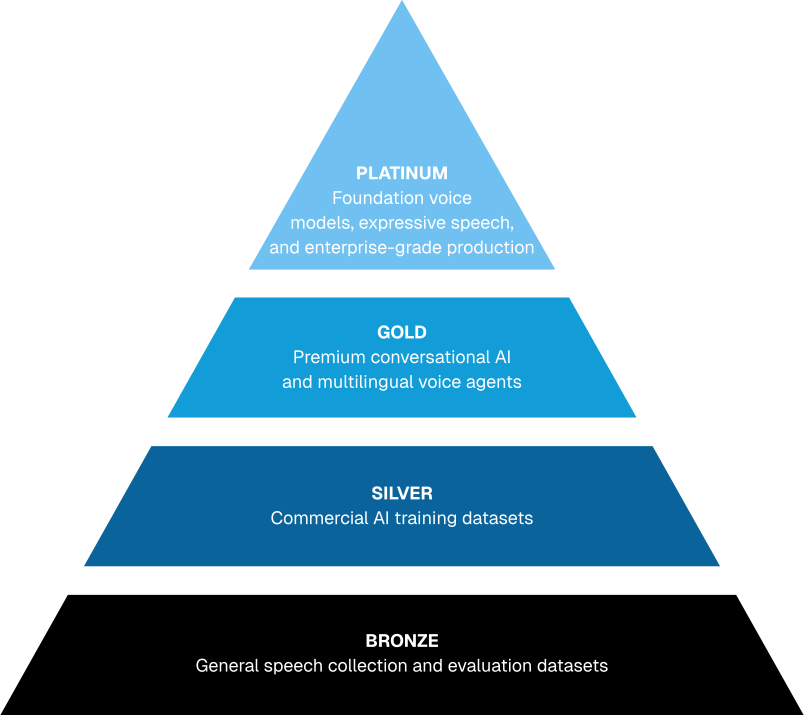
DataForce is developing a structured certification framework for AI voice production, establishing measurable standards for recording environments and voice talent.
| Framework Area | Evaluation Criteria |
| Studio certification | Acoustic treatment, recording environment, equipment quality, signal consistency, engineering practices, reliability, security, and quality management. |
| Voice talent certification | Language proficiency, accent authenticity, vocal consistency, emotional range, conversational performance, direction-following, and professionalism. |
Certification Tiers
Quality, Security & Governance
For enterprise AI teams, dataset quality directly influences model performance, development efficiency, a nd user trust. DataForce integrates quality controls throughout the entire AI voice lifecycle rather than treating QA as a final review step.

Recruit
Participant qualification, identity verification, language validation, and demographic alignment.

Record
Recording environment validation, audio engineering review, and file-level inspection.
Annotate
Transcript verification, diarization checks, label consistency, and reviewer validation.

Deliver
Metadata validation, dataset completeness checks, manifest review, and delivery acceptance testing.
Industries & Use Cases
Foundation Voice Models
- Large-scale multilingual data
- Expressive speech
- Multi-speaker dialogue
- Long-form conversations
- Rich metadata
Conversational AI & Voice Agents
- Task-oriented dialogue
- Customer support simulations
- Interruptions
- Turn-taking
- Clarifications
- Follow-up questions
Customer Experience
- Contact center scenarios
- Emotional variation
- Sales and support terminology
- Appointment scheduling
- Financial services
- Retail interactions
Healthcare
- Medical terminology
- Privacy-conscious workflows
- Diverse patient populations
- Multilingual support
- Human-reviewed annotations
Automotive
- In-vehicle acoustics
- Multiple occupants
- Background noise
- Natural commands
- Regional accents
Robotics
- Spoken instructions
- Real-world acoustic conditions
- Safety-critical contexts
- Varied interaction patterns
Education
- Conversational tutoring
- Natural questions
- Expressive speech
- Adaptive dialogue
- Multilingual learning support
Accessibility
- Natural voice interaction for users with visual, motor, cognitive, or communication-related accessibility needs.
Frequently Asked Questions
AI voice infrastructure is the end-to-end ecosystem for creating production-ready voice datasets, including recruitment, recording, transcription, annotation, QA, metadata engineering, and secure delivery.
Traditional speech recognition focuses on recognizing spoken words. Modern AI voice systems must understand and generate natural conversations, emotional expression, speaker interaction, and multilingual communication.
Real conversations include interruptions, pauses, laughter, overlapping speakers, emotional variation, and contextual changes that scripted recordings cannot capture.
Poor audio quality introduces noise into training data, reduces annotation accuracy, and can negatively affect model performance. Consistent recording standards improve dataset reliability and downstream AI outcomes.
Yes. Programs can combine professional recording studios, certified home studios, and managed remote recording workflows depending on project goals, languages, and locations.
Yes. DataForce recruits participants across a broad range of languages, dialects, and regions, helping organizations expand voice AI beyond high-resource markets.
Datasets may include transcripts, timestamps, diarization, language identifiers, emotion labels, acoustic conditions, recording environment data, and custom metadata.
Standardized workflows, multi-stage QA, centralized governance, and certification frameworks help support consistent outcomes across regions and production models.
Ready to Build the Next Generation of Voice AI?
Whether developing a foundation voice model, launching multilingual AI voice agents, evaluating conversational AI systems, or expanding into emerging markets, DataForce provides the infrastructure to create secure, representative, production-ready voice datasets.
Schedule a consultation with one of our AI voice specialists to discuss your next project and discover how enterprise voice AI infrastructure can accelerate development and scale multilingual voice experiences.
Success Stories.
We've partnered with thousands of companies around the world. View a selection of our customer stories below to learn more about how DataForce has helped clients excel in the global marketplace.
DataForce Benefits.

Scalable
Onboard up to 1000 annotators within weeks of project kickoff, leveraging a global community of over 1.3 million contributors.

Secure
Your data is secure with SSAE 16 SOC 2, ISO 27001, HIPAA & GDPR.

Seamless
Integrate directly with the DataForce annotation platform—your own or a third-party solution.